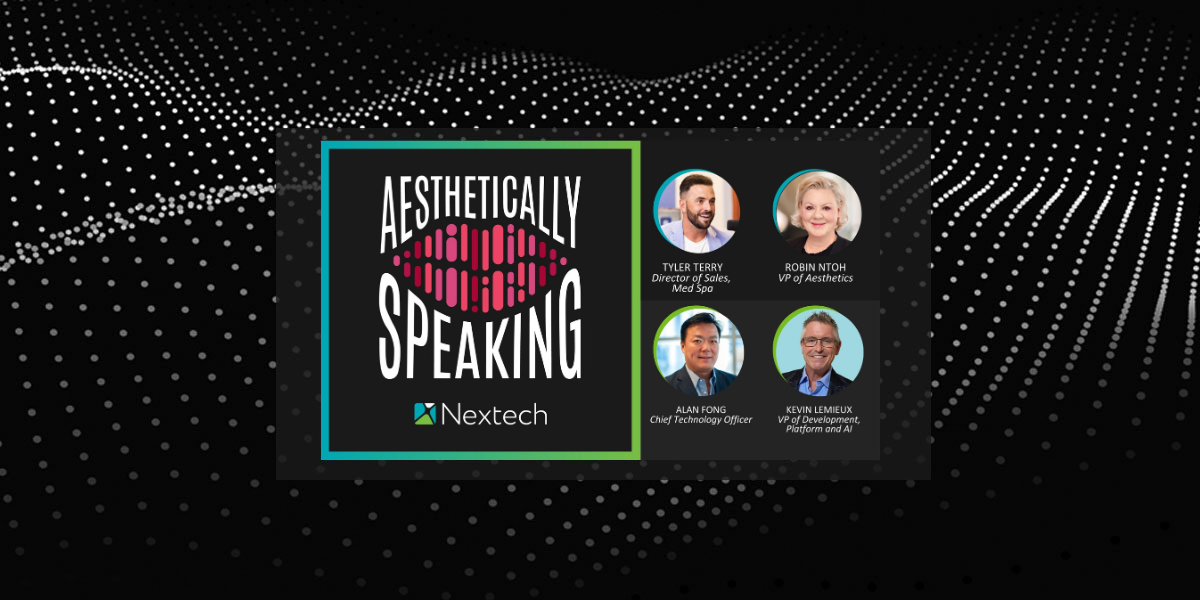
Alan Fong (CTO) and Kevin Lemieux (VP of Development, Platform and AI) share an exclusive look into how AI helps aesthetic practices thrive.
Dispelling fears and misconceptions, Nextech’s technology leaders highlight how AI plays an increasingly meaningful role both behind the scenes in your everyday business and across each stage of the patient’s aesthetic journey.
Listen
Watch
Guests
Alan Fong, Chief Technology and Product Officer
Alan brings over 20 years of experience in executive leadership roles across healthcare, enterprise workload management, and telecommunications. He holds a BASc in Computer Engineering from the University of Waterloo, beginning his career as an engineer, and quickly transitioning into executive leadership roles with notable success at PointClickCare, FleetComplete and Dealer-FX. In 2019, he was a finalist for Canadian CIO of the Year with iTAC.
Kevin Lemieux, VP of Development, Platform, and AI
With over 20 years of experience leading product, engineering, operations, and quality engineering teams around the world, Kevin is passionate about building scalable and highly performance and intuitive solutions that deliver emotional delight to millions of users.
Kevin started his career working with the consulting company Concero, designing and building solutions across the United States for companies such as Canon, Entrepreneur Magazine, and The Associates (now Citi).
Hosts
Tyler Terry, Director of Sales, MedSpa at Nextech
Access Robin's toolkit of helpful resources to help optimize practice operations»
Transcript
Announcer (00:06):
You are listening to the Aesthetically Speaking podcast presented by Nextech.
Tyler (00:13):
Hey guys, welcome back to the Aesthetically Speaking podcast. I'm your host, Tyler Terry, and I'm here with my co-host Robin Ntoh. We are at Edge, our annual users conference in Las Vegas. This is actually our 10th annual, so it's a huge deal for the company. And today we're actually here with two very special guests. We have our Chief Technology Officer, Alan Fung, and we also have Kevin Lemieux who is our VP of Development, Platform, and AI. Welcome to the podcast.
Alan Fong (00:49):
Thank you for having us.
Kevin Lemieux (00:49):
Yes, thank you for having us here.
Robin (00:51):
So excited you guys are here today. We have all kinds of things to talk about, so.
Alan Fong (00:54):
Oh, can't wait.
Tyler (00:57):
It's going to be a fun topic. Lots to talk about.
Robin (01:00):
You know Tyler, it's really funny because chat GPT has become more commonplace. In fact, I recently was talking about this within our women in tech and we were looking at how do we use technology such as AI to really help us and not feel like we're cheating. Like, oh no, I'm cheating. I'm doing this and I really shouldn't be. And so we have to kind of embrace the good and then really think about is there something that we need to understand about this within the healthcare space? And I think there's a lot going on. I feel like there's a press release almost every day with a different type of AI that's in play or it's coming out in a different type of platform that's available. And I mean, how do you keep up with it? There's just so much going on. I mean, Kevin, I would say to you, when you think about this based upon your unique perspective on it, I mean, what has been the most exciting thing that you've seen from healthcare when it comes to in general AI?
Kevin Lemieux (01:57):
I think what's really interesting, you mentioned about it being a buzzword, and again, you think back the evolution, cloud computing, and now with artificial intelligence, a lot of technologies have actually been here for quite a while. When you take a look at recommendation engines from Netflix and you look at other areas, a lot of those technologies have been maturing over time. What's really exciting now is being repackaged as AI with additional elements such as natural language processing, computer vision, robotics, et cetera. There's so many great applications in the healthcare space, and again, it's still in the infancy and a lot of new developments that I know we'll talk about here today are coming out, but it's a great pioneering place for us to be building upon.
Robin (02:33):
Yeah. And I think that people are still a little afraid of it. You have a vast amount of knowledge around it, and you think about these practices and how they perceive it, and especially in our space, the practices, the specialties that we work in, it can be a little overwhelming. But Tyler, you see this and you've been talking to people about this. What have you seen?
Tyler (02:52):
I've seen so many different use cases and so much excitement around it. I think people are really just excited to see where it goes and are just curious what the future looks like five, 10 years from now and how automobile companies are going to use it, how our cell phones are going to advance, what does it mean for our kids when they're going to school and how can they use it? And to your point, Robin, sometimes it's a new tool that almost feels like we're cheating because it gives us that instantaneous knowledge and feels like it's writing out work for us. I mean, even for me, when I was writing a few of my talks, I'm getting ideas and then I'm asking it to give me bullet points and I felt like, oh my gosh, am I doing this right? Is it okay to be doing this? And the answer is, yes, it is. And the key is going to be, in my opinion, on the user and how we control it and how we dictate it and having the knowledge. So I would love to learn from both of you, Alan.
Alan Fong (03:50):
Absolutely. You gave some really good examples there. And don't feel ashamed because I recently used chat GPT to help with my 8-year-old son's math homework, and it really helped out, so that was great. I felt a little bit bad, but it worked out well. But what we're seeing a lot of is a lot of different AI concepts and innovations come out there, and I think what people are doing is throwing something through wall to see if it sticks, if there's real value from that, that's part of what we're always looking at as well.
Tyler (04:18):
Yeah. So what are some ways that each of you are actually using it in your everyday life? Alan, you mentioned using it with your son's homework, but I'll start with you.
Alan Fong (04:27):
Yeah, no, so a lot of things at home, I use it a lot for the visual AI side of things. I don't know if you guys have played around with it using gene AI to actually come up with realistic images. Yes, I tried this early on and it would come up with humans that had six fingers and whatnot, but now they have five fingers. It actually works and it's been great and it's fun to play around with my kid and my wife and family, but I also bring that to work now as we generate different images for different presentations and things.
Tyler (04:56):
That's awesome. My little girls have two little girls and they love coloring and I've been making coloring pages for them. They'll just tell me something, use their imagination, and boom, we print it out. So Kevin, how are you using it?
Kevin Lemieux (05:07):
So very similar to Alan, three children in grade school. My daughter, she's in her AP calculus, and so trying to make up examples off the top of your head is a little difficult, but it's just really amazing. You talked about the assistance when I was back in grade school. You go to your Encyclopedia Britannica and you look there. Then in college, oh, I go to the internet to do research. This is just that new and exciting tool you can leverage to augment what you're trying to do. So at home, similar type of things. My daughter had her birthday, so we generated the invitation with a Mama Mia theme, which is pretty cool. Helping with kids at school and then home automation, whether it be setting the lights and the mood to watch a movie coming on and different things, but a lot of wonderful applications of technology with AI.
Robin (05:42):
Guys, you're giving me a lot of great ideas over here because I didn't even think about some of the things that you're thinking of, and I think that just kind of speaks to the breadth of how much you can do with this that we just haven't even really explored. It's like the title is, The Art of AI Possibilities, and where we go with it.
Tyler (05:59):
Super exciting. So let's break it down a little bit, and Alan, when we're talking about ai, how does it work? Is there a simple way of understanding what it does?
Alan Fong (06:09):
Yeah, you think about traditionally how this all evolved, machine learning, data analytics and analysis and to get to AI, and then now more recently, Generative AI, really it brings a more centered or human-centered approach to how you interact with responses. So you take a lot of data together, you put it into what we call a large language model. It analyzes all of that and comes up with the response that's really human-centered, it has some empathy around it and really gives you direct responses as if you were talking to somebody.
Tyler (06:39):
Wow.
Robin (06:40):
Wow. It's a lot to take on you know, when you think about it. Where do you think that that has an impact on our space and healthcare? How do you think that that's going to be perceived?
Alan Fong (06:52):
Yeah, maybe Kevin, we can tag team on that one.
Kevin Lemieux (06:54):
Sure thing.
Alan Fong (06:55):
I think about administrative efficiencies, right? You go into a practice office and you think about the practice staff. There's the billing side of things. It's really complex. When I was on an onsite visit, you see the biller always on the phone trying to get things corrected, billing efficiencies like risk of errors and things like that. So a lot of areas like that where we can really help and use AI because there's lots of data around billing and claims and everything else. The other part is around the clinical side. So if you think about AI scribing, which is a hot topic, our vision of getting to a screenless encounter where the provider and the doctor only has to deal or talk to the patient facing them instead of going back to their keyboard and trying to type something up. So a screenless encounter, and I think Gen AI is really going to help with that.
Robin (07:41):
I mean, we went from paper to EMR and now we're going to the next level, and it's just fascinating to see how technology continues to evolve. While it might be a little frightening and people might feel that it's going to take away their job if they think about it, it's like you said, it allows them to focus on the patient. The concept is very exciting if you think about it and how it could really revolutionize and give back a lot of time to physicians in the practice, but also give that patient what they're used to or what they need, something they don't know.
Alan Fong (08:16):
And speed to that outcome is also very helpful. With Gen AI, you think about diagnostics, all the data you get from the medical record and images now from MRIs and CAT scans, you can use Gen AI to come to a faster potential outcome that the provider can then use to make a decision.
Tyler (08:34):
Wow.
Kevin Lemieux (08:35):
It's also really interesting because even prior to a visit, you look right now, a person may be experiencing something, they go to Google, they research it, or the wearables you're wearing your Fitbit or your Apple Watch or you're using an app to watch what you're eating, and that too. All the advancements of sensory devices and monitors, what it's going to be able to do is bring attention to about something that might be starting to come up and bring that to the office. So that way you're not waiting until it's too long and it just allows you to enter into that experience a lot sooner, which again is going to be fantastic for better medical outcomes for patients.
Tyler (09:07):
Yeah. Especially with that more proactive approach. That's incredible. What I start to think of is 15, 20 years ago when practices started to adopt electronic medical records, the way that they're able to differentiate themselves from their competition because they're adopting new technology and they're able to have that speed so that they have more time with their patients. And I'm excited for practices to be able to be the first to adopt the new technology so that they can have that same benefit so that they can have more time taking care of their patients, so that they can have more time potentially even with their families. So, very exciting. Kevin, what are some misconceptions do you feel like people have about AI?
Kevin Lemieux (09:49):
A real big one is jobs. Oh my gosh, we're going to lose our jobs. What's great is the efficiency is going to help, and I think Robin, you mentioned before too, it's not about necessarily losing jobs per se, it's about liberating time to providing better outcomes. So when you think about it, if you are working in a practice and there's a repetitive task and all our jobs, we have different repetitive tasks, but if you can use AI to speed that up or automate that process now with your cup of coffee, you have a few more minutes to do something different and that's going to allow you to again, do better, more efficient administration in your office or provide better patient outcomes to the patients you serve.
Alan Fong (10:23):
Right.
Kevin Lemieux (10:24):
So yeah.
Alan Fong (10:25):
I don't care who you are. You don't wake up in the morning and come into work and say, you know what, first thing I'm most excited about is logging into my EHR. They studied healthcare, they wanted to become a provider or a practice staff, and that's what their passion is.
Tyler (10:40):
Yeah.
Robin (10:41):
We know that physicians do not go to school to learn coding, that's for sure.
Alan Fong (10:44):
That's right.
Robin (10:45):
That's one of the bgger problems. And so if this is an outcome of it, think about how it's going to really revolutionize and change the way that we think about just certain KPIs that have been a status quo for so long. We're going to change all of that with something as simple as putting in place technology that reduces the input of error, it's fascinating.
Kevin Lemieux (11:07):
It's interesting you talk about the reducing the input of error. When Alan was describing previously about in layman's terms, how the technology works, what's really interesting, you hear about large language models, but just in general, imagine something whereby you're analyzing an image, see if there's potential skin cancer. What's great about all these different artificial intelligent engines is you just think of these massive amounts of data and every day, every week, every month that passes by. You're putting more models into this. And what's great is these systems can continue to evolve and learn to get more and more accurate, which I think is great because they're literally getting smarter as we speak.
Tyler (11:42):
It's crazy that just by the patient coming into the practice and AI learning about the patient's health history and potentially any of their interests and the AI being able to obviously predict outcomes or being able to be intuitive enough to provide better care. Alan, are there any emerging companies or leaders in the development of AI that we should follow or pay attention to?
Alan Fong (12:08):
Yeah, there's the obvious ones like OpenAI and Google Gemini, the ones that we talked about earlier. But you know what? The pace of innovation is so fast in this space that I bet you six to 12 months from now, we're going to see new players because the value adoption is going to be there. More data is going to be available to make these things more accurate, and once that happens, we're going to see these new leaders of emerge.
Kevin Lemieux (12:30):
It's interesting too because in addition to the big players and upcoming ones, the way in which technologies have been assembled for artificial intelligence, it makes it quite easy for individuals to enter the space. We talked about already using it at home for Generative AI, but a software engineer who can code to the cloud and code webpages, they have the ability to tap into these very powerful models and systems. So I think what's interesting, if we are sitting back a year from now or five years from now, there's going to be somebody that we're reading about, Joe and Sally sitting in the garage, that are going to build this amazing new AI enterprise. So what it's doing is it's also an equalization so that more and more people can take advantage of these very interesting tools.
Robin (13:07):
Wow, fascinating. I feel like we're back when computers became a thing and they just exploded and totally changed our world, and it feels like we're on the cusp of that again, and it's exciting working in software and technology and even aesthetics to think about how this will impact our lives, not just from the perspective of how we work as a business, but how we work with our customers, our clients, and how we can support them in so many different ways.
Tyler (13:35):
Yeah, definitely. So when I opened up, I talked about as a consumer, I was so used to going to Google for any knowledge, and now I'm going to chat GPT. Does it feel like patients will do the same thing? A lot of patients go to Dr. Google. Do we feel like chat GPT or AI will take over that for Google?
Alan Fong (13:57):
Yeah, a hundred percent. You think about this new generation where we saw an example earlier, the patient's sitting on their sofa at home or the beanbag chair at home and they expect certain services to come to them. Sort of like the DoorDash, Uber type style, right?
Tyler (14:11):
Yeah.
Alan Fong (14:12):
So you think about a patient interacting with a practice, I want to schedule my appointment online. I want to do it anytime during the day or evening if I wanted to. So the practice has to be available 24/7. And then you go through that entire patient journey of checking in. I'm at the front office and I have to do my document intake and gather my patient demographics and whatnot, and then you go through the whole procedure and posts and what happens after when you get home, and you want to reengage with that patient too and bring them back to the practice if you need to. So that whole cycle, using AI to help predict a lot of those things and make sure that it's available 24/7 is going to be very impactful.
Kevin Lemieux (14:53):
It's also interesting, we have to be really mindful. Again, previously you go to Google and you're asking a question, you get a number of links and then you can use your own acumen to figure out is this a reputable source or not a reputable source? It's amazing to have that conversational type engagement with generative AI, but when you ask a question, it's like you're sitting across from somebody giving an answer, but unless you ask for it to quote your different references, you don't really know what that data is originating from. So I think something that's going to be exciting, but something we also have to be careful of is the integrity of the data that we're being presented, and I think that's something we'd really be interesting to follow. I know there's a lot of great advances going in that area, but it's just something to be mindful of.
Alan Fong (15:27):
Yeah, that's super important actually. A lot of hallucinations that happen today and 87% accurate in healthcare may not cut it, but it is important and the speed to that outcome is what can help inform a provider to make a better decision.
Robin (15:42):
You bring up a really important point when you think about the risk now that may be associated with this, and we've seen in the news there's been regulation that's come down. How do you think that that's going to impact technology and healthcare technology as next tech as a company that's evolving and bringing this into our practices and what we're bringing forth? How do you think that that's going to impact?
Alan Fong (16:05):
Yeah, we all love regulatory and compliance, right? I'm sure, but in reality, it's actually really good because of the things we just talked about. You're bringing in sort of guidelines that we have to adhere to, so make sure that decisions that are made aren't just wide open field decisions. They're like they follow certain guidelines, follow certain data sets, follow what's required to make sure that we provide a safe informed ethical decision.
Kevin Lemieux (16:31):
And companies too. What's really exciting about this revolution with AI that I'm seeing is there's a focus from the get-go of what are the moral compass or the ethical impacts, and I think that a lot of companies as they're emerging with their AI strategies are being very clear from the get go to say, what does this mean for us? And I think that's going to be so much more helpful for adoption because people are afraid of new technologies and by articulating and then being held accountable for what you're identifying from an ethical perspective would be really helpful.
Tyler (16:57):
You think of practices and when they're curating content for their website or their social media and how they have to be mindful of that and how ai, it'll be interesting to see how practices do the same thing with that technology. So I want to shift gears a little bit, and Robin, you have seen technology advance and you've helped so many practices actually transfer from paper to EHR, which was a monumental step for our industry and for medical in general. Do you recall any learnings from supporting doctors through that shift that would be helpful as we go through another big shift in tech?
Robin (17:38):
Yeah, no, I think one of the big things that comes to mind is change is difficult for any practice, no matter what it is, and so there's a lot of fear around change and how I manage it, and so some of the things that have really helped in practices is really bringing the staff into the decision making process and helping them see the value. What is this going to do for me? How is this going to help me, not just what is it going to do for the patient? What is it going to do for the physician? What is it going to do for the business, but how is this going to help me as a user or as a staff member in taking the time to give them an opportunity to validate and vet their fears is a really good way for them to then buy into it and then see the advantage.
(18:24):
Because a big thing about AI is it's going to replace my job, but in effect, it really just makes them more efficient so that they're not making as many mistakes or we're processing things faster and we're getting that speed to revenue. So engaging with your staff at a very core level and having open conversations and understanding their fears is a really important step to actually making sure that as you start to see this coming into play, it will help the practice and the staff really engage better and embrace it. So the buy-in from them and the training are two key things that really help.
Tyler (19:04):
Do you feel like it was the leader of the practice that really helped to drive that or was it a specific demographic that latched onto it first? Was it a younger practice, a more tech savvy practice, a practice that was just right in the middle of thriving in their business, who were the early adopters?
Robin (19:25):
So many ways to think about that. Young new physicians obviously will only go into new technology because they recognize that's the impact of what they had in their learnings and their education, so they want to follow through with that. It's also part of the older generation of physicians are starting to realize or did realize if they want to be relevant, if they want to attract young new physicians, then they have to have that technology forward thought process. But at the end of the day, technology is a change for the practice and how they process it and bring that into play is going to be important. One of the things that we've had to do as a business is think about how we partner with the practice. We can't just drop in new training materials and new ways to do things. We have to help coach them. So a lot of times we find our implementation teams coaching practices and showing them How do I help my staff overcome this? How do I help my staff actually incorporate these new processes into my practice?
Tyler (20:25):
Yeah, I think once you realize that it's here to stay, and Easton who makes sporting equipment, they have a saying, play with it or against it, and I think once you realize that it's, I either need to practice with this or potentially practice against it, you know, when my competitors or my colleagues are using it and I'm not, I'm not going to reap those benefits and my patients and my staff, they're not going to reap those benefits, so.
Alan Fong (20:51):
Absolutely. I've never been to a staff or a practice where they have an overabundance of time, so I think one of the key value props is we can make this so much more efficient that you have lots of time to do what you really want to go do.
Robin (21:04):
I think about all the things that they say they can't do or they don't have time to do. There really are elapses in the whole patient journey, those gaps that really force them to not focus on the patient, which is critical these days because we spent so much time at this conference talking about patient engagement because it is the new go forward, and so if we can give them tools and show them how those tools make their day better, those are going to make the difference.
Kevin Lemieux (21:31):
What's really interesting too is in conferences such as EDGE, having the opportunity to talk to so many different practice owners and different people in different roles is back in product and engineering. We have some amazing great ideas what we wanted to do, but when you actually are talking to individuals or going on site and seeing people experiencing the pain point where they have it, that's where that true secret sauce comes that inspiration for new ideas, and when you're talking about it's training after that, but it's being inspired and partnering with them upfront, understand what problems they're having so that when they get something back, they have this emotional reaction, this emotional acceptance to the feature you're bringing in that's going to help them with their adoption.
Robin (22:06):
Well, considering that this is aesthetically speaking podcast, let's talk about aesthetics a little bit in AI and where that might fit into this space. What are we developing or what are we thinking about or what are we hearing that are some needs that we might be able to solve for with AI?
Alan Fong (22:20):
Yeah, there's probably a couple of things that we can touch on there, but when we think about helping our practices thrive, that means how do we drive more revenue for those practices and at the same time provide value to their customers? One of the areas we've been looking at applying AI is at the point of sale, so really suggesting products or services that go along with the procedure that they just had and really being direct on it. It's not just listing five different products or really thinking about what did they have before, what procedure did they have, what applies most to them so that it can be suggested at the point of sale.
Robin (22:52):
That revolutionizes what happens at the checkout. It really coaches the staff on what they need to do. Especially think about it, if it's a brand new staff member, they may not understand it. I mean, I'll go into practices and they might have 50 different products and how do they know what they should be thinking about, but if all that information is collected and evaluated, think about the power of that in a practice and what that would do just for their revenue.